
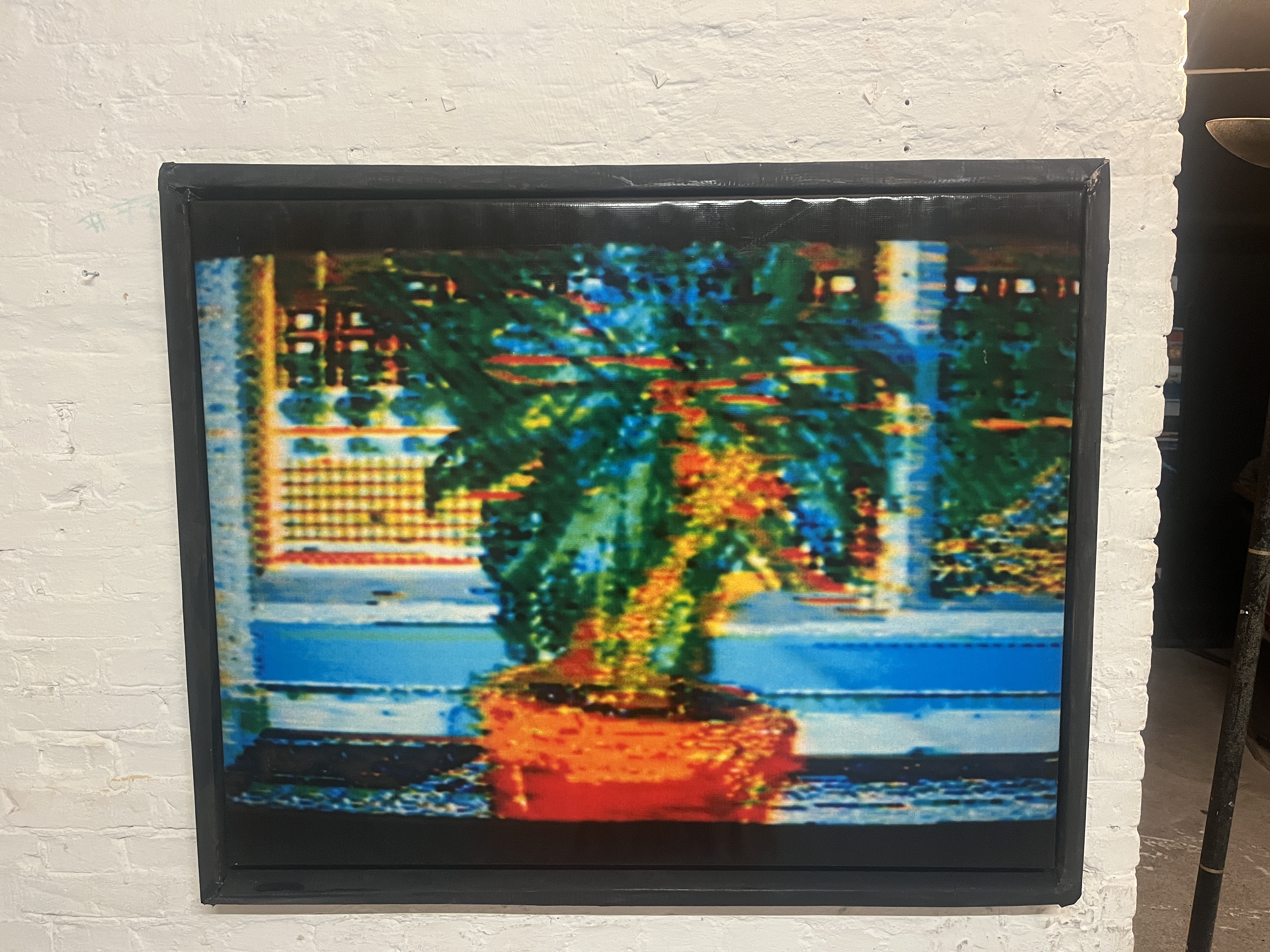
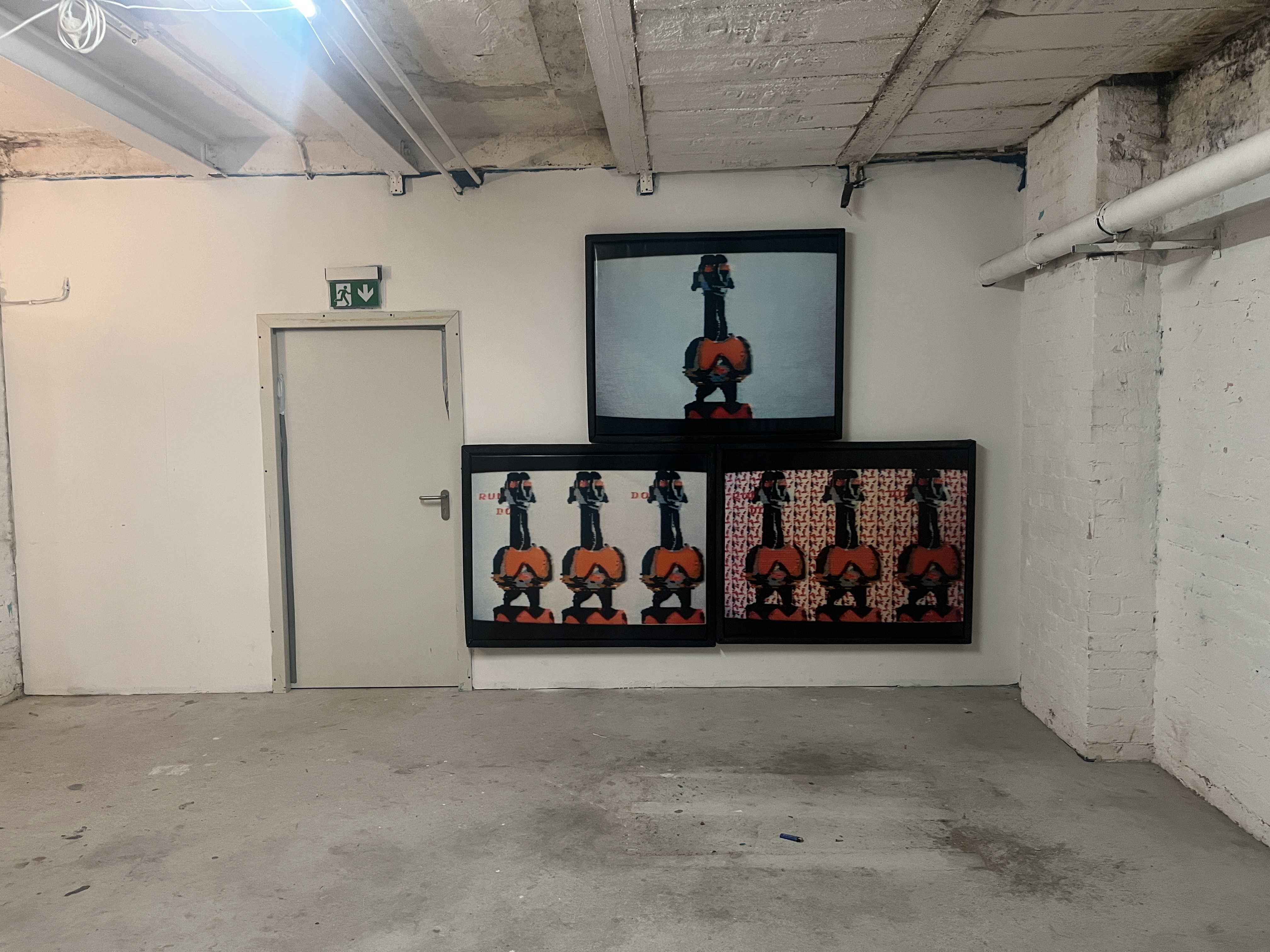
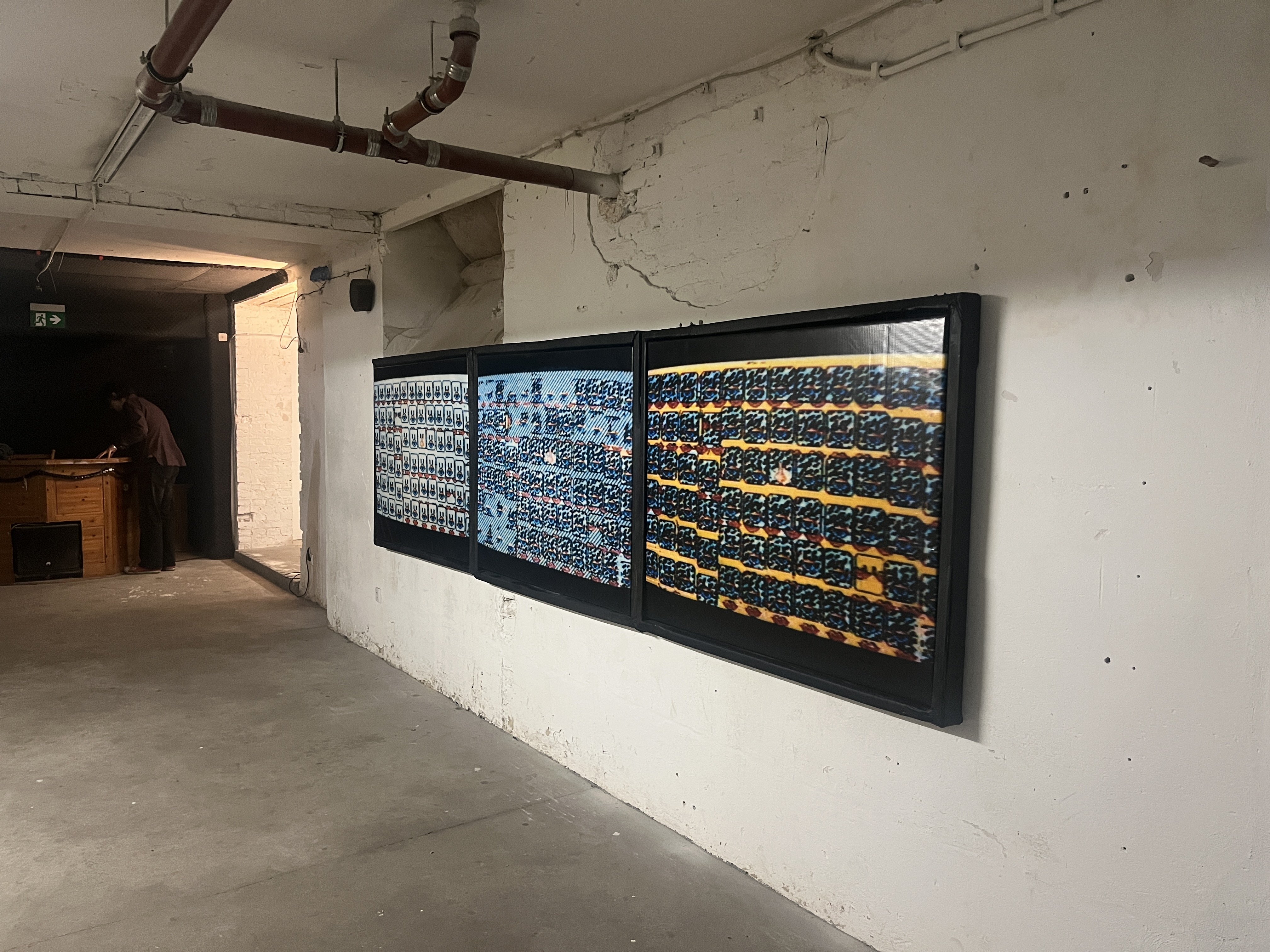
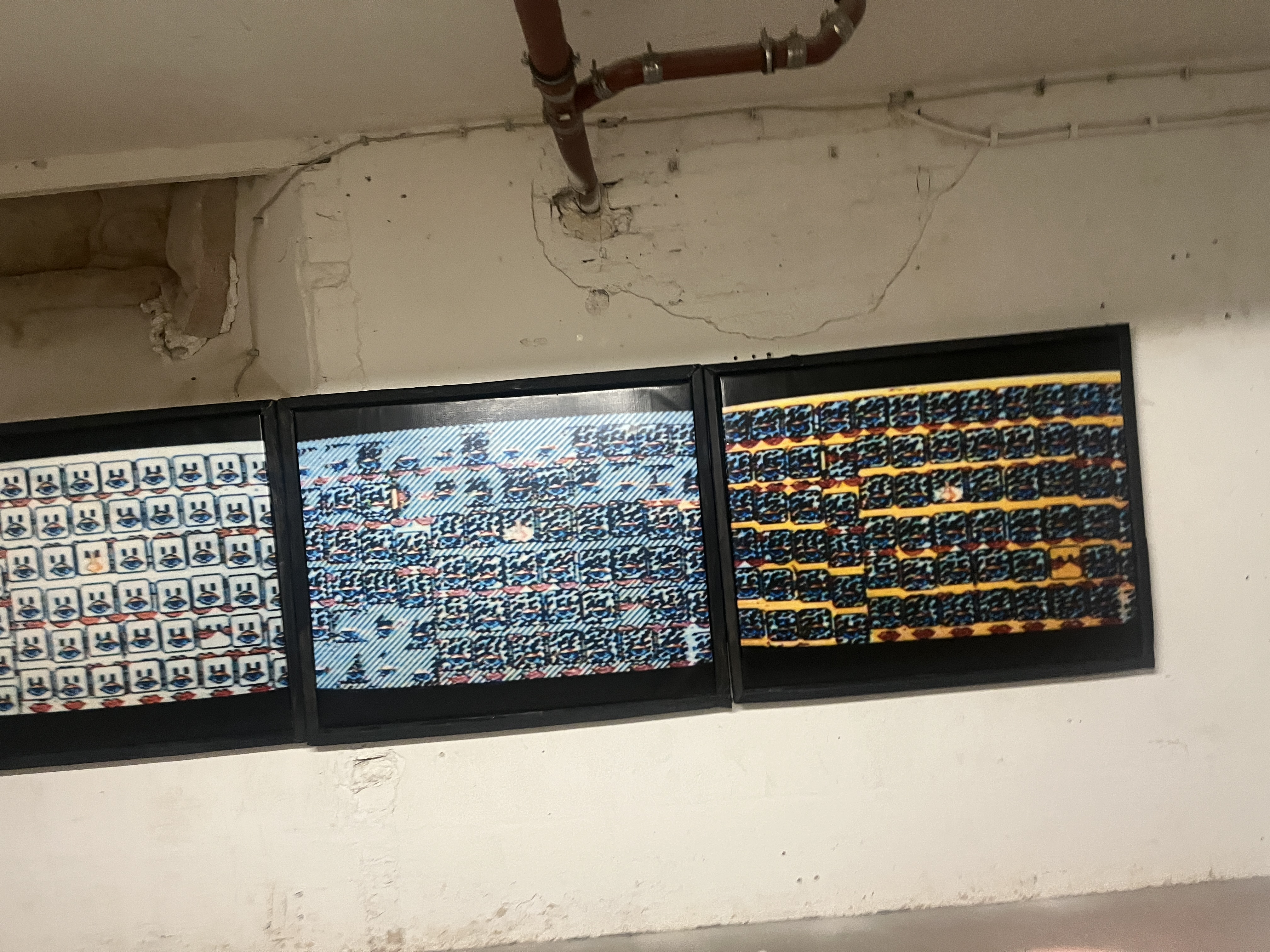
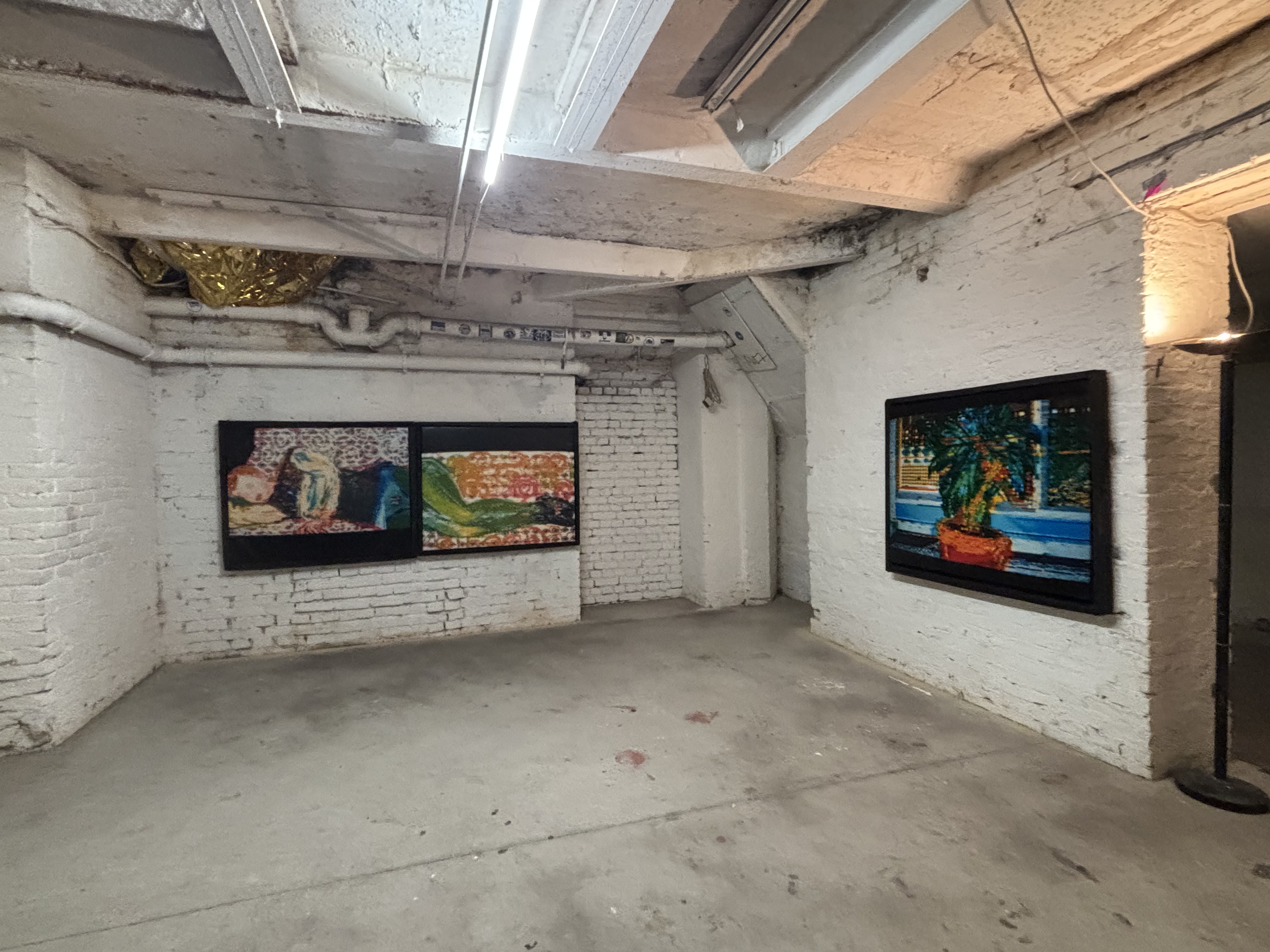
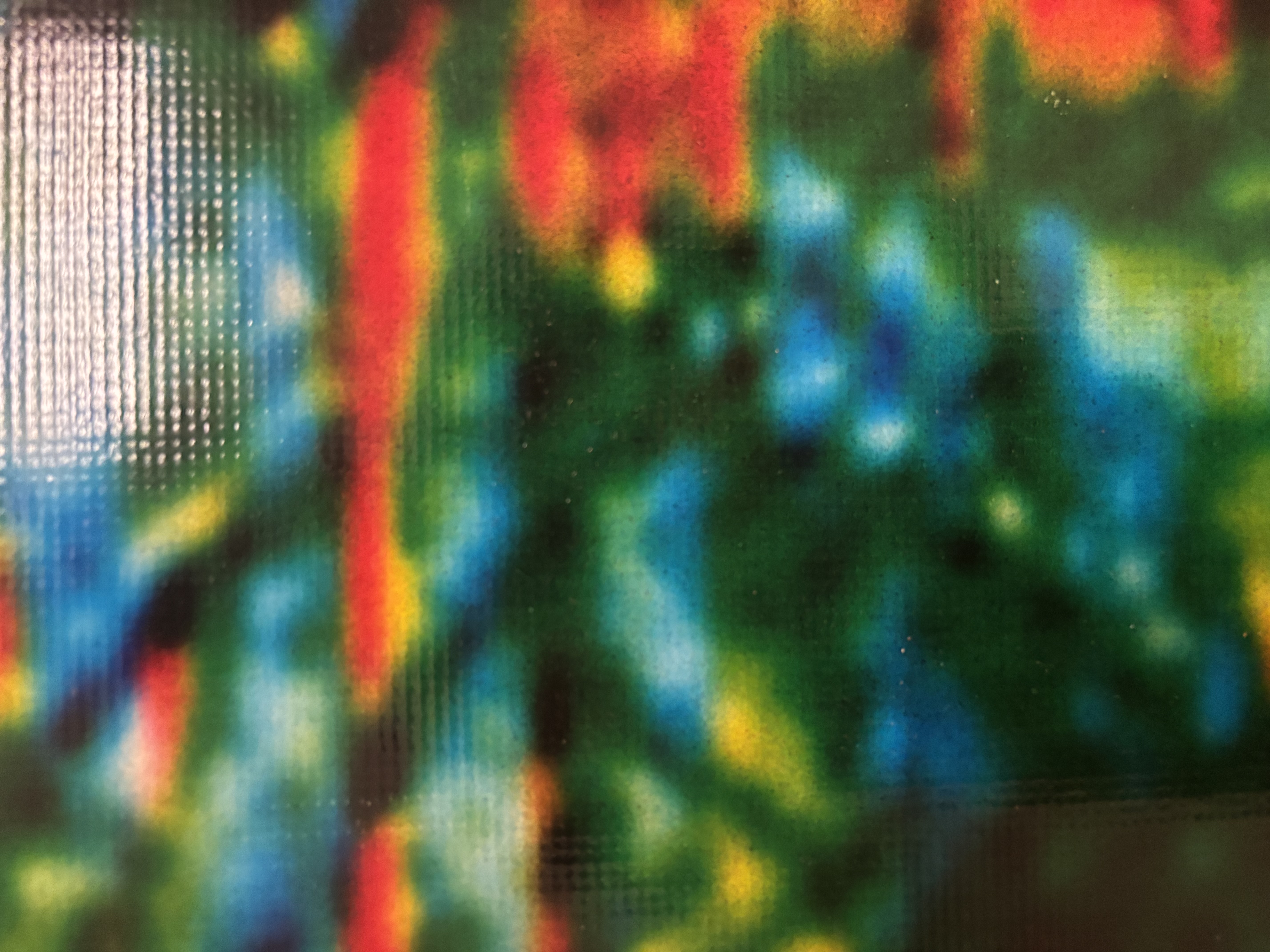
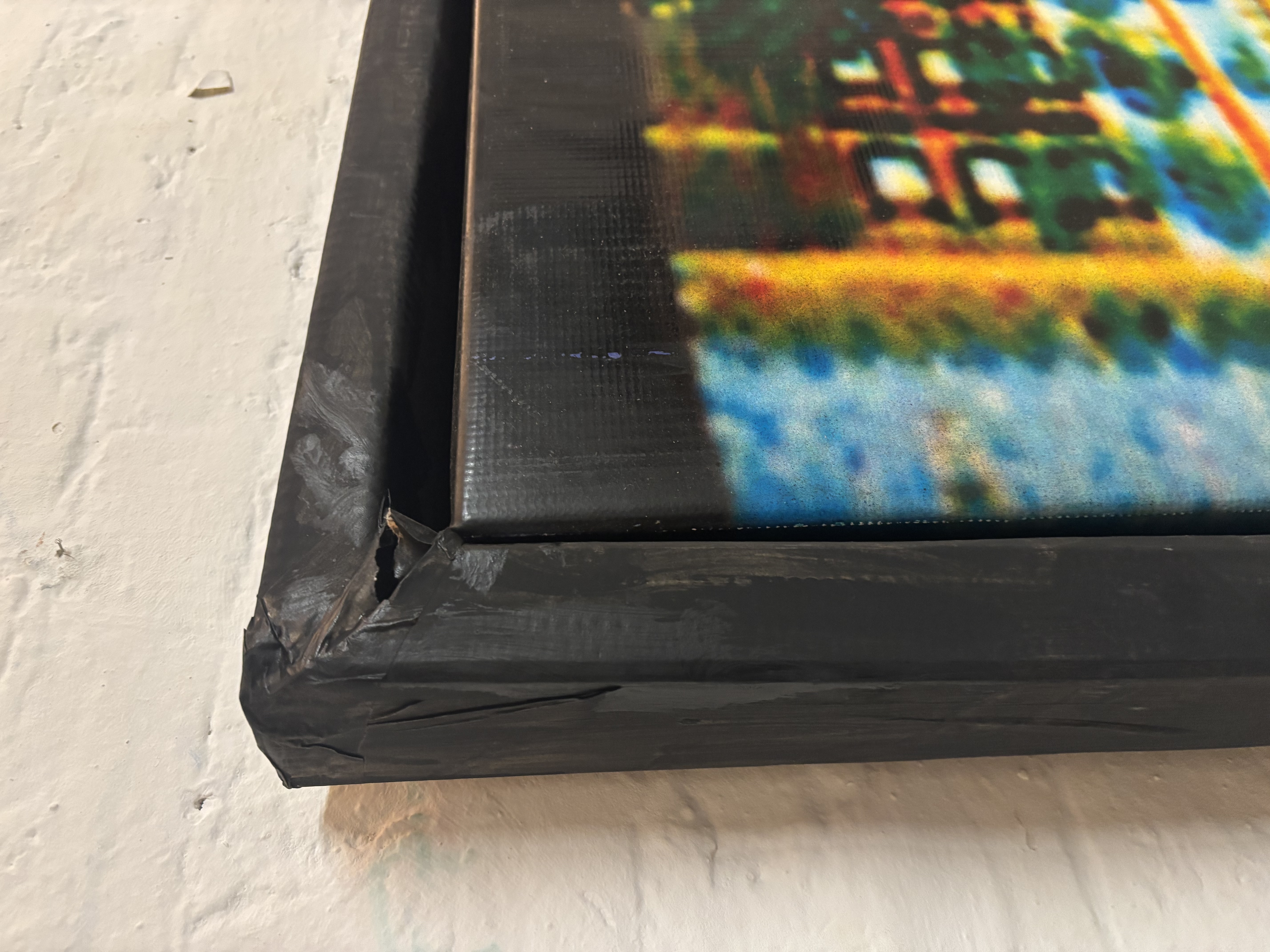
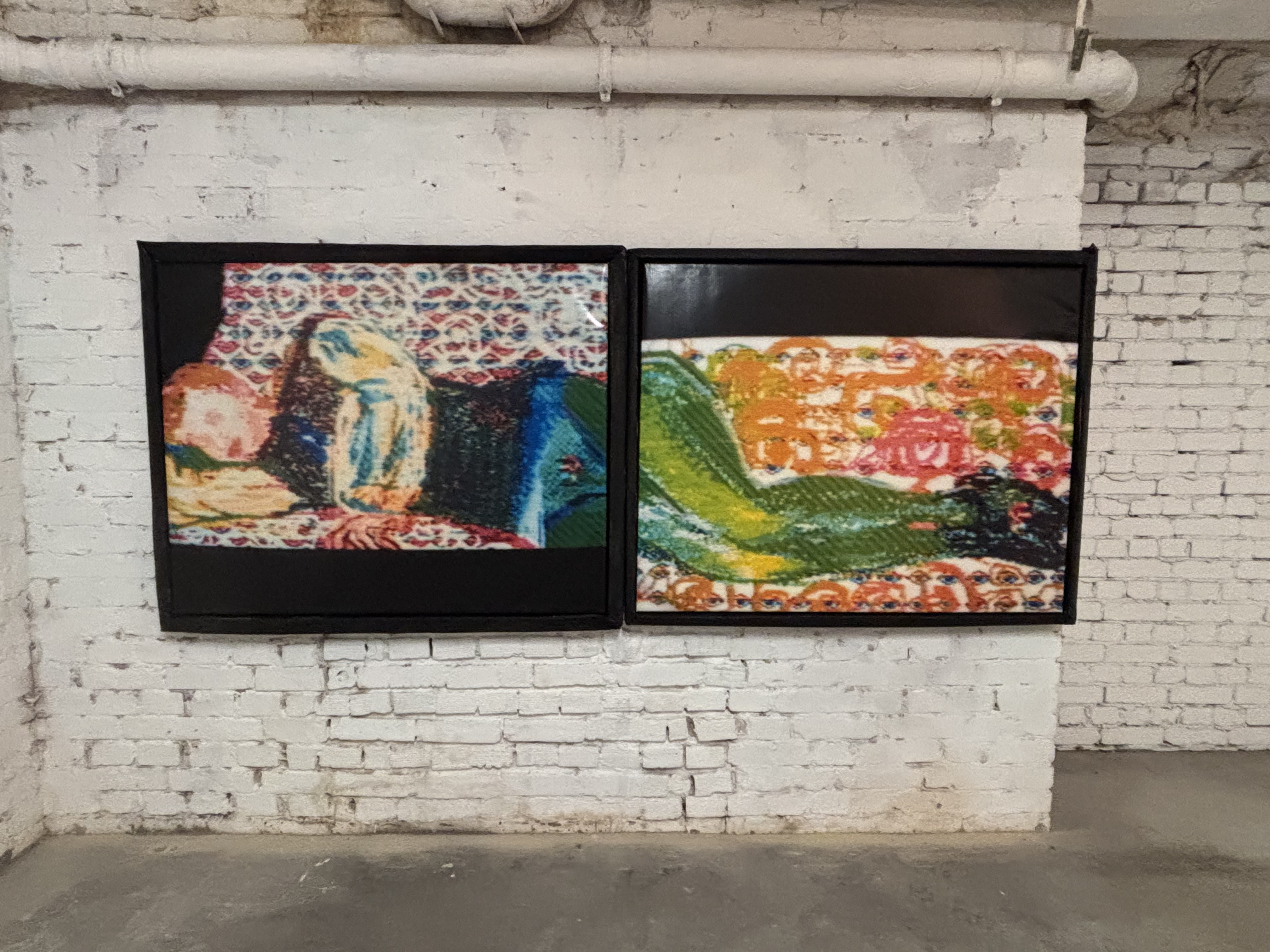
Triptychs Early Footage Roy Lichtenstein Lilliputian Totem Murderous Remorse The germ of these paintings was a marvellous little machine, devised in Canada in late ‘70’s consciously poised to revolutionize communications between artists, countries and whole continents. It was a compact, early prototype computer called Telidon, and it was adept at text processing and narrow-casting- and its graphics capabilities were coming quickly. Only one space in Toronto had access to it, an artists-run gallery called Inter Axis, and you could book time to try it out. When it was my turn, I turned instinctively to art for inspiration- in fact, to an artist, the sculptor Nobby Kubota. I digitally rendered a 3-D image of Nobby’s head, then got his mouth to actually move. WOW. Telidon, conceptually ahead of its time, promised a revolution that it, sadly, wasn’t in a position to deliver. Within a year or two, Macs and PCs had swept Telidon and its Teletext software away like collateral damage in the path of an avalanche. But what’s fun to remember is the possibilities it floated, its tease and its ideals- it felt as if the whole world was on tenterhooks to see what the art world could come up with next. Everything up til then had been pretty low tech- FAX’s, Gestetners (a printer popular for creating limited run magazines), Xerox, later colour Xerox. Hardly imaginable now, but there was a time when it seemed that sending text messages, then images, between computers, would be the stunning development that changed everything (and it was, but not in the way that we imagined). I remember a conceptual artist from New York suggesting that we might even be able to contact other planets. That early digital tech feels like it was invented a few centuries ago, because developments since then have raced exponentially. But art moves in a different way, more like stutters steps, going forward and reversing, as it defines its pathway forward. For Barnett Newman, painting was the Voice of Fire. Painting with pixels may be its fingertips. I started playing Super Mario in the Nineties- a friend’s kid had it hooked up to her TV set, and I was quickly hooked. Mario was a fantastic hero- Luigi and The Princess were great too, but it was Mario the powerful magician who reimagined fairy-tales. He is like Siegfried’s opposite number- the golden demi-god, who never worked a day in his life, vs. the flat-cap day labourer under the counter, whose magic tricks keep modern life going. The game’s colours and symbols- keys, mushrooms, giant pipes, moulded bricks, etc. (you know them all) went through dazzling transformations without any violence, similar to the transitions a painting goes through. A program you could buy (for about $10.00) for the Nintendo Entertainment System was SuperMario Paint. It provided a rudimentary palette, as well as a few of the symbols from the game, which you could use to produce images on the TV screen using the game’s own joy sticks. By this time, games played on PCs were popular on other platforms than Nintendo- XBox, PlayStation, etc., and there were advanced graphics programs like 3D Studio, which allowed the user to build a complete, lighting-controlled facility on your desktop. But I liked the television perspective, sitting some distance away from the screen while creating images. And the unpretentious settings were simple and intuitive, in order to be useful to kids. I started by depicting objects in the room, then moved to re-presenting images off the television screen itself. The game itself had one memory setting- in other words you could keep 1 image to screen-capture later- but if the images were being constantly changed, as they would be, I couldn’t track the transformations. I then discovered that I could record the changing pictures as video, and when I got to where I wanted them to be, I could do a screen freeze and grab, which I could then photograph. Those photographs became the printing images. (I found that the images could also be expressed as video, with musical composition possible. I did this for one of the images, “Murderous Remorse”, before deciding that the still image was the result I was actually going for). The printing was on double-sided, textured vinyl, by a printing plant in Etobicoke, that generally specialized in highway billboards, so the ink was mixed to be permanent, and the material itself very durable. Most of the images were conceived in 3’s, as triptychs. The rationale came out of the process itself, similar to different states of a printing plate. Except that much of the detail accumulated was also transitory- it would exit the screen to make room for other elements entering, in the spirit of the moving image. I should say something about the rationale for my approach to constructing these images. Their apologia is ludic philosophy, by which I mean structured play. So the toolbox I’ve chosen is a game- I would have said “child’s game”, except that these tools aren’t inherently age intensive, just like paint has no age limits, upper or lower. The “Constuctivist Education” championed by Jean Piaget is a touchstone, marrying his ideas about early childhood education, to the influence on my work of Constructivism. I’ve also used the “Supersprayer” water guns in paintings, as well as Nintendo’s “Fine Art Academy”, in a series of portraits I made of the regular habitues of a certain Toronto cafe, which I called “DSXL Cafe @ Mitzi’s”. Finally I must credit the late paintings of Philip Guston, finally becoming widely know in the ‘90’s, that opened a channel for tragi/comic grandeur and lushness in painting.
… this place sure has deteriorated beyond all possible expectations. Somehow it feels like I just got out of a coma—plucked out of it and put right back on the street knowing I’d been in a coma but not for how long, trying to guess from the available evidence, but disappointed and confused to find that time and place no longer really seem to function here, not as I know them. All signs of the alteration have been frozen in renovations eternally clean, pasty, unmoving. Like the vital needs of energy and movement have been outsourced elsewhere, or like they discovered cryogenics for cities before people. Hell, maybe I’m just having a stroke. Honestly, much of the time these days you’d hardly notice. I first moved here in 2001 after finding a room on Craigslist. It was in an old coach house on a narrow side street. The ad—for a roommate, posted by the other prospective tenant—didn’t bullshit about the derelict condition. Rent was very cheap, especially with the two of us. There were lingering notes of horse shit even though the horses were long gone, obviously. The mice drew a regular crowd of neighbourhood cats who seemed to prefer ours over their owners’ company. The floors slanted up like the deck of a sailboat tacking against a strong wind, probably due more to the renovations—a species of pernicious incompetence—than the original structure, which was solid. We had to adapt, correct our bodies’ inherent biases toward the straight and level. The only level floor space in the coach house was in a corner of the bedroom on the ground floor, technically mine, though after a while we tended to skulk about somewhat like the cats between houses. That was because Dave kept his flatscreen TV there in the flat corner. It was a Samsung, large and rectilinear and monolithically black like nothing else in the dilapidated house, hence very incongruous. Neither of us could have afforded a thing like that then at market price. Dave worked as a busboy at Filmores across town, claimed he’d gotten it from a biker in exchange for a day’s labour. Personally, I wouldn’t have trusted Dave then if I’d thought I had anything to lose by it. Dave and I were both 18 then and new to Toronto. We had our preconceptions from movies like Crash and Exotica—all false of course, a city being something that needs to be repeatedly guessed at and projected upon, whether because of a vitality which largely eludes or because it leaves so much to be desired or both. Either way, the individual has to make it up for themselves, while these foreign investors come and jack up the property values. But we also had our impressions from having spent a good part of the 90s watching MuchMusic on TV. Before then, the TV screen had been such an overtly remote, passive thing, for decompressing, coming down from the hazards of lived experience. Until MuchMusic came along with its live-air, street-level programming. The pinnacle for the young teenager being the rare moments when somebody showed their tits or talked about how paranoid and horny they were before they could be live-edited out. All carefully cultivated and baked into the production, I have to assume. A few years downstream of MTV, effectively a cultural propaganda platform serving up certain Toronto-based versions of music and culture to the nation’s youth. Still, it allured with the sense of a new format developing more or less in realtime, thus inevitably infused with doses of chaos, risking some level of compounded exposure to the city’s seedy diffusions, however pre-programmed the leakage. And the people no doubt gave it what they learned to want from it, with teenagers in the background daring each other to show things they imagined couldn’t be unseen. Definitely touched on some limit to the medium many probably dreamed of surpassing. In this it was not the first, but it was definitely a timely catalyst. By the time I moved to Toronto, the station had long ago veered back toward the dominant tendencies of the medium rather than somehow figuring out a way of expanding or renewing its sense of the unscripted, exposed, interactive. Not that it ever really inspired an expectation of the reverse, despite its suggestiveness. Walking back from those limits was, of course, the beginning of the end. And now, there’s not even any sun-bleaching around the area the sign used to occupy. It has in fact been replaced by something fully sanitized, bereft of life, hardly situated in time and space at all. I can at least say that its absence is felt. Incidentally, one day I came home from work and Dave had dismantled the flatscreen, carefully, methodically, keeping all its component parts—from the screen and casing to the tiniest